Ml-Models-Exercise

Preliminaries

library(tidymodels)
── Attaching packages ────────────────────────────────────── tidymodels 1.4.1 ──
✔ broom        1.0.12     ✔ recipes      1.3.1 
✔ dials        1.4.2      ✔ rsample      1.3.2 
✔ dplyr        1.2.0      ✔ tailor       0.1.0 
✔ ggplot2      4.0.1      ✔ tidyr        1.3.2 
✔ infer        1.1.0      ✔ tune         2.0.1 
✔ modeldata    1.5.1      ✔ workflows    1.3.0 
✔ parsnip      1.4.1      ✔ workflowsets 1.1.1 
✔ purrr        1.2.1      ✔ yardstick    1.3.2 
── Conflicts ───────────────────────────────────────── tidymodels_conflicts() ──
✖ purrr::discard() masks scales::discard()
✖ dplyr::filter()  masks stats::filter()
✖ dplyr::lag()     masks stats::lag()
✖ recipes::step()  masks stats::step()
library(tidyverse)
── Attaching core tidyverse packages ──────────────────────── tidyverse 2.0.0 ──
✔ forcats   1.0.1     ✔ stringr   1.6.0
✔ lubridate 1.9.5     ✔ tibble    3.3.1
✔ readr     2.1.6     
── Conflicts ────────────────────────────────────────── tidyverse_conflicts() ──
✖ readr::col_factor() masks scales::col_factor()
✖ purrr::discard()    masks scales::discard()
✖ dplyr::filter()     masks stats::filter()
✖ stringr::fixed()    masks recipes::fixed()
✖ dplyr::lag()        masks stats::lag()
✖ readr::spec()       masks yardstick::spec()
ℹ Use the conflicted package (<http://conflicted.r-lib.org/>) to force all conflicts to become errors
library(ggplot2)

rngseed <- 1234
set.seed(rngseed)

dat <- readRDS("dat_clean.rds")

glimpse(dat)
Rows: 120
Columns: 7
$ Y    <dbl> 2690.52, 2638.81, 2149.61, 1788.89, 3126.37, 2336.89, 3007.20, 27…
$ DOSE <dbl> 25.0, 25.0, 25.0, 25.0, 25.0, 25.0, 25.0, 25.0, 25.0, 25.0, 25.0,…
$ AGE  <dbl> 42, 24, 31, 46, 41, 27, 23, 20, 23, 28, 46, 22, 43, 50, 19, 26, 3…
$ SEX  <fct> 1, 1, 1, 2, 2, 1, 1, 1, 1, 1, 1, 1, 2, 2, 1, 1, 1, 1, 1, 1, 1, 1,…
$ RACE <fct> 2, 2, 1, 1, 2, 2, 1, 88, 2, 1, 1, 1, 1, 1, 2, 2, 1, 1, 1, 1, 1, 1…
$ WT   <dbl> 94.3, 80.4, 71.8, 77.4, 64.3, 74.1, 87.9, 61.9, 65.3, 103.5, 83.0…
$ HT   <dbl> 1.769997, 1.759850, 1.809847, 1.649993, 1.560052, 1.829862, 1.850…
More processing

dat <- dat %>%
  mutate(RACE = case_when(
    RACE %in% c(7, 88) ~ 3,
    TRUE ~ as.numeric(RACE)
  ))

table(dat$RACE)

 1  2  3 
74 36 10 

Pairwise correlations

library(GGally)
Warning: package 'GGally' was built under R version 4.5.3
dat %>%
  select(Y, DOSE, AGE, WT, HT) %>%
  ggpairs()

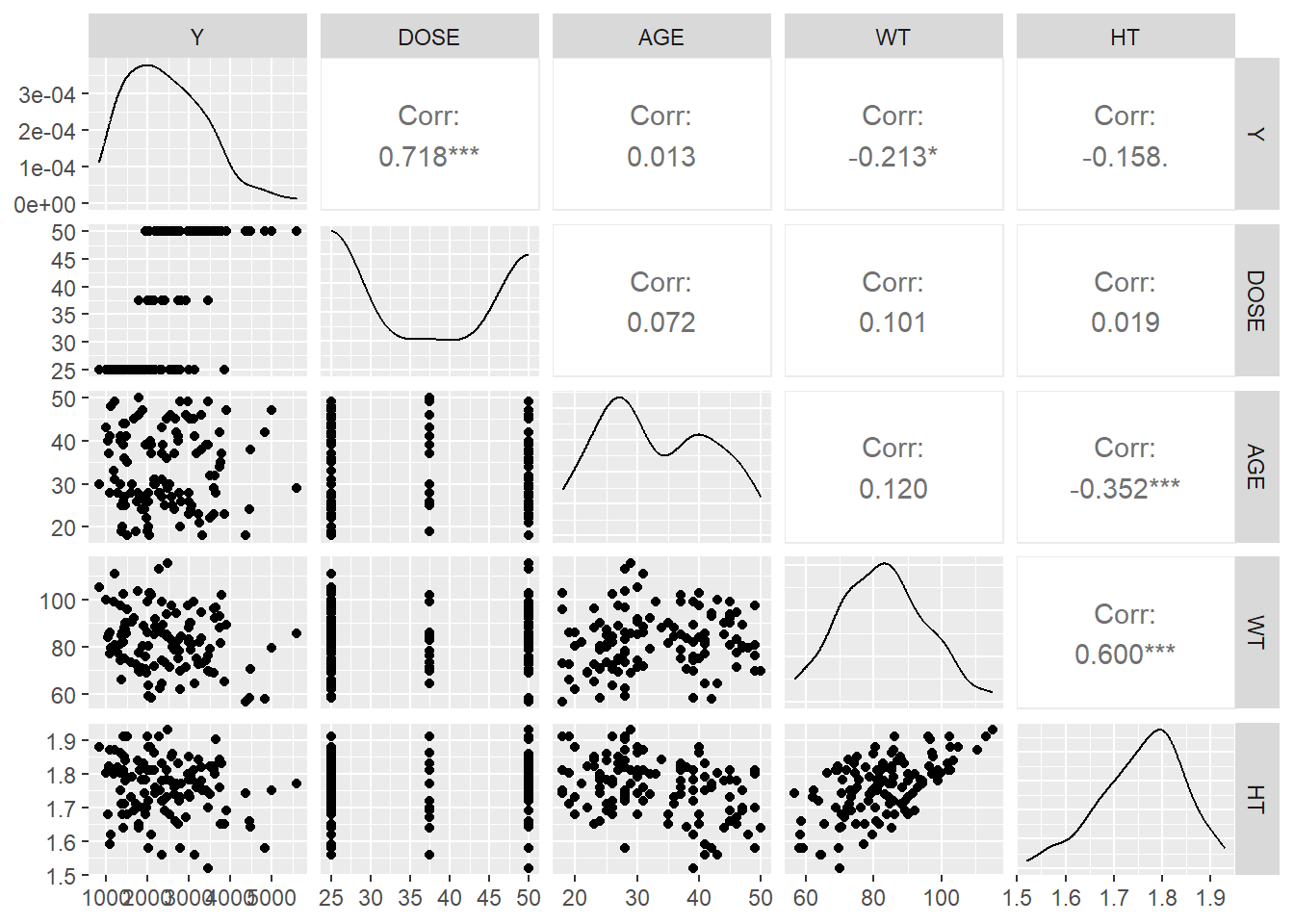
The pairwise correlation plot shows that some variables are moderately correlated, such as dose and outcome (Y), and weight and height. However, none of the correlations are extremely high (e.g., above 0.9), indicating that multicollinearity is not a major concern in this dataset.

Feature engineering

dat <- dat %>%
  mutate(BMI = WT / (HT^2))

summary(dat$BMI)
   Min. 1st Qu.  Median    Mean 3rd Qu.    Max. 
  18.69   24.54   26.38   26.63   29.70   32.21 

A new variable BMI was created using weight and height, defined as weight in kilograms divided by height in meters squared. Based on the observed values, no unit conversion was required.

Model building

formula <- Y ~ DOSE + AGE + SEX + RACE + WT + HT + BMI

First Fit

Linear model (Model 1)

lm_model <- linear_reg() %>%
  set_engine("lm")

lm_workflow <- workflow() %>%
  add_model(lm_model) %>%
  add_formula(formula)

lm_fit_first <- fit(lm_workflow, data = dat)

lm_pred_first <- predict(lm_fit_first, new_data = dat) %>%
  bind_cols(dat)

rmse(lm_pred_first, truth = Y, estimate = .pred)
# A tibble: 1 × 3
  .metric .estimator .estimate
  <chr>   <chr>          <dbl>
1 rmse    standard        581.
ggplot(lm_pred_first, aes(x = Y, y = .pred)) +
  geom_point(alpha = 0.7) +
  geom_abline(slope = 1, intercept = 0, linetype = "dashed") +
  labs(
    title = "Observed vs Predicted: Linear Model",
    x = "Observed Y",
    y = "Predicted Y"
  ) +
  theme_minimal()

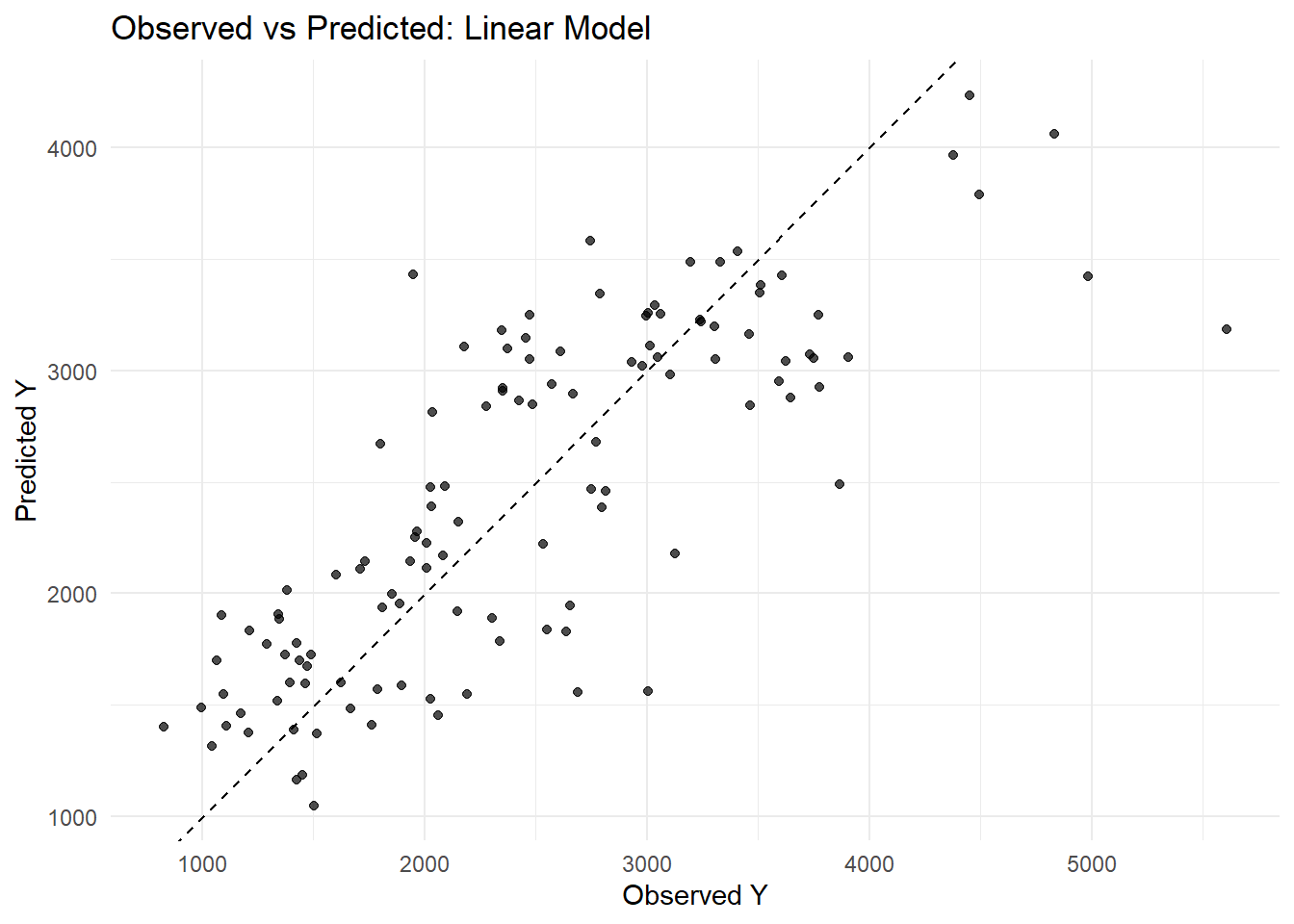
The observed versus predicted plot shows that predictions generally follow the diagonal line, indicating reasonable agreement between predicted and observed values, though some variability remains.

LASSO model (Model 2)

lasso_model_simple <- linear_reg(penalty = 0.1, mixture = 1) %>%
  set_engine("glmnet")

lasso_recipe <- recipe(formula, data = dat) %>%
  step_dummy(all_nominal_predictors()) %>%
  step_normalize(all_numeric_predictors(), -all_outcomes())

lasso_workflow_simple <- workflow() %>%
  add_model(lasso_model_simple) %>%
  add_recipe(lasso_recipe)

lasso_fit_first <- fit(lasso_workflow_simple, data = dat)

lasso_pred_first <- predict(lasso_fit_first, new_data = dat) %>%
  bind_cols(dat)

rmse(lasso_pred_first, truth = Y, estimate = .pred)
# A tibble: 1 × 3
  .metric .estimator .estimate
  <chr>   <chr>          <dbl>
1 rmse    standard        581.
ggplot(lasso_pred_first, aes(x = Y, y = .pred)) +
  geom_point(alpha = 0.7) +
  geom_abline(slope = 1, intercept = 0, linetype = "dashed") +
  labs(
    title = "Observed vs Predicted: LASSO Model",
    x = "Observed Y",
    y = "Predicted Y"
  ) +
  theme_minimal()

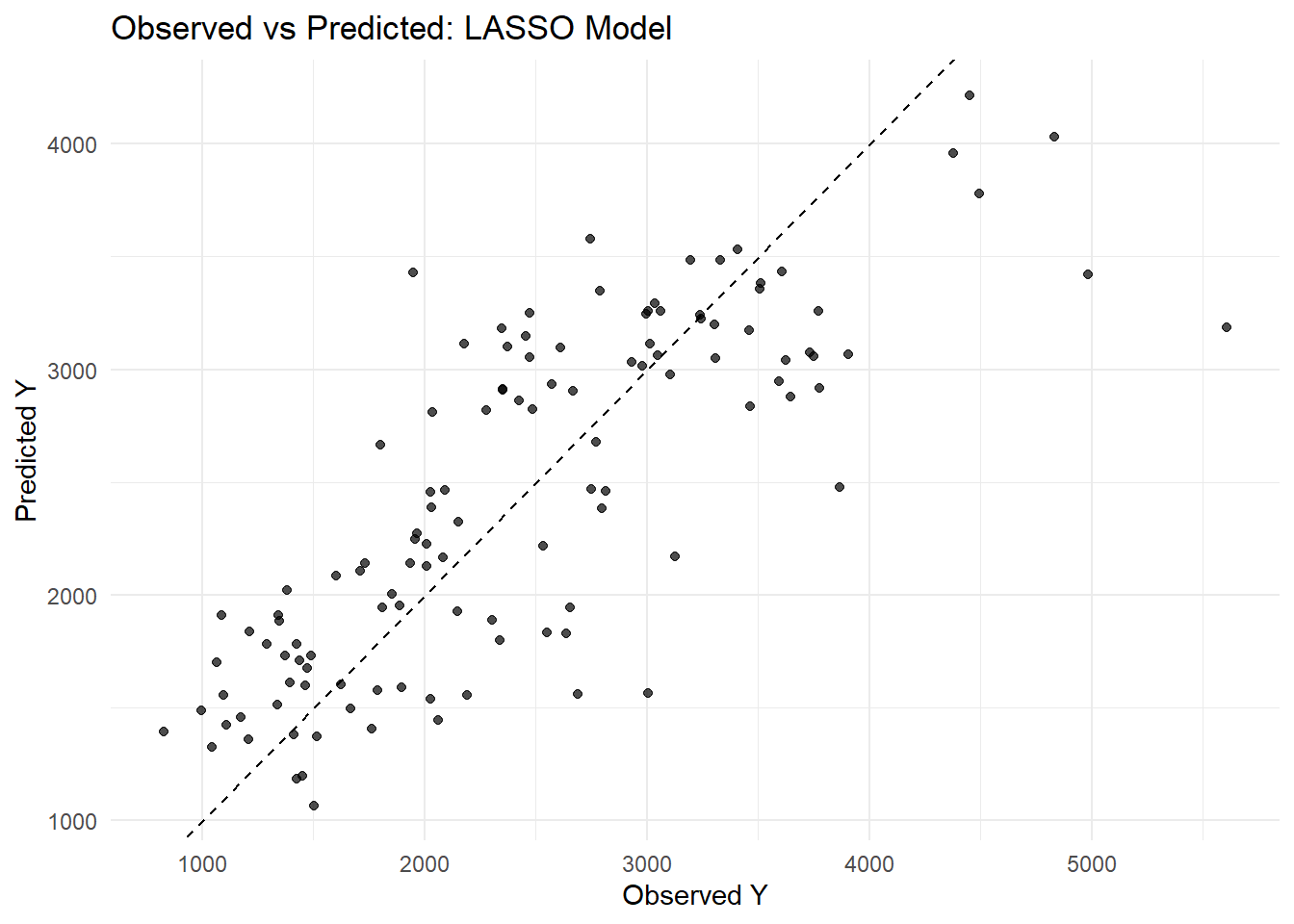
The LASSO model produced nearly identical results to the linear regression model, with an RMSE of approximately 581. This is expected because the penalty parameter is relatively small and does not strongly shrink the coefficients, making the model behave similarly to standard linear regression.

Random Forest (Model 3)

rf_model_simple <- rand_forest(trees = 500) %>%
  set_engine("ranger", seed = rngseed) %>%
  set_mode("regression")

rf_recipe <- recipe(formula, data = dat) %>%
  step_dummy(all_nominal_predictors())

rf_workflow_simple <- workflow() %>%
  add_model(rf_model_simple) %>%
  add_recipe(rf_recipe)

rf_fit_first <- fit(rf_workflow_simple, data = dat)

rf_pred_first <- predict(rf_fit_first, new_data = dat) %>%
  bind_cols(dat)

rmse(rf_pred_first, truth = Y, estimate = .pred)
# A tibble: 1 × 3
  .metric .estimator .estimate
  <chr>   <chr>          <dbl>
1 rmse    standard        359.
ggplot(rf_pred_first, aes(x = Y, y = .pred)) +
  geom_point(alpha = 0.7) +
  geom_abline(slope = 1, intercept = 0, linetype = "dashed") +
  labs(
    title = "Observed vs Predicted: Random Forest",
    x = "Observed Y",
    y = "Predicted Y"
  ) +
  theme_minimal()

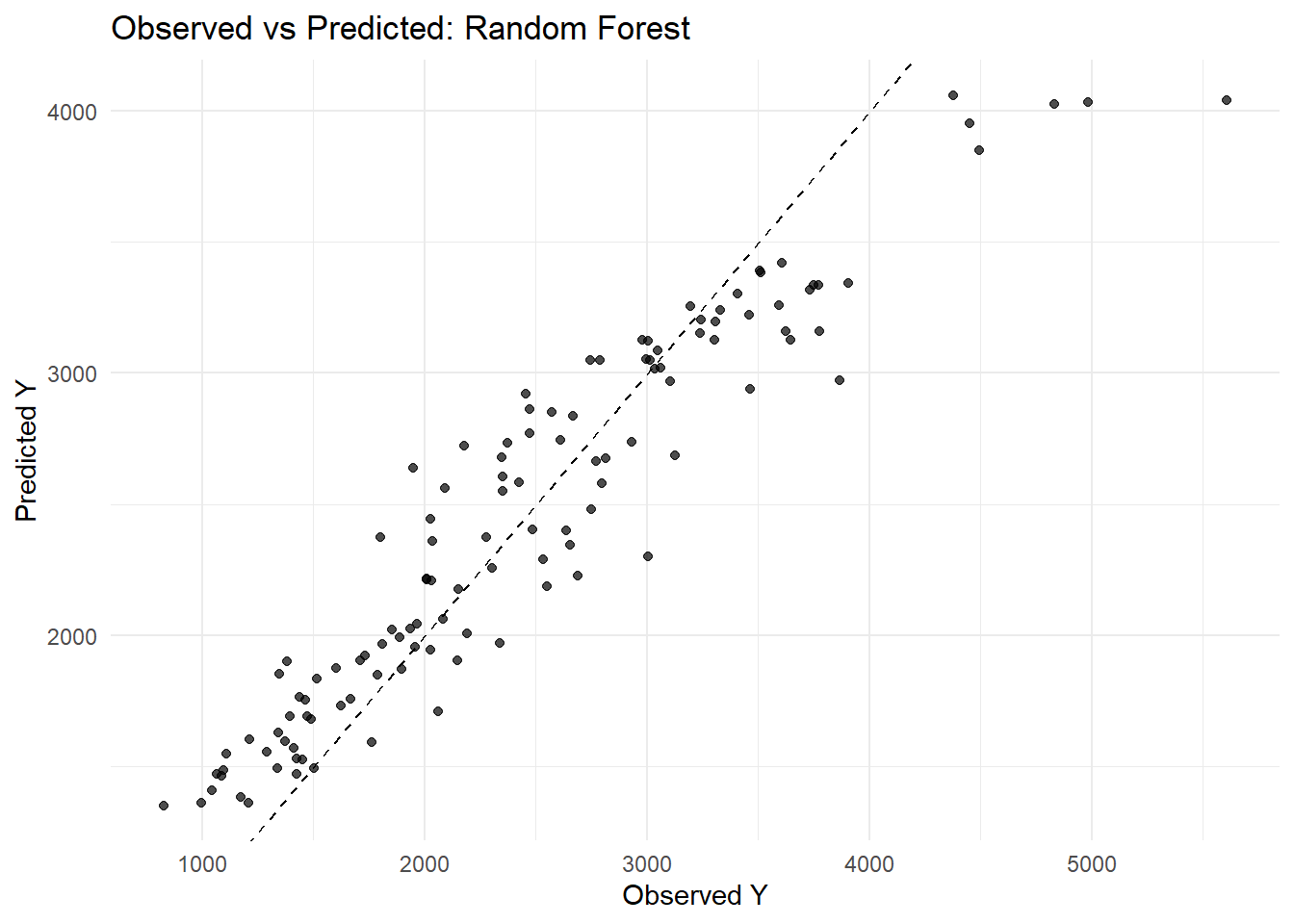
The random forest model achieved the best performance in the first-fit setting, with an RMSE of approximately 359, which is lower than both the linear and LASSO models. The observed versus predicted plot also shows predictions closer to the diagonal line. This indicates that random forest fits the training data very well, although this strong performance may reflect overfitting rather than better generalization.

Tuning the models

LASSO tuning without CV

lasso_model_tune <- linear_reg(penalty = tune(), mixture = 1) %>%
  set_engine("glmnet")

lasso_recipe <- recipe(formula, data = dat) %>%
  step_dummy(all_nominal_predictors()) %>%
  step_normalize(all_numeric_predictors(), -all_outcomes())

lasso_workflow_tune <- workflow() %>%
  add_model(lasso_model_tune) %>%
  add_recipe(lasso_recipe)

lasso_grid <- tibble(
  penalty = 10^seq(-5, 2, length.out = 50)
)

lasso_app <- apparent(dat)

set.seed(rngseed)

lasso_tune_no_cv <- tune_grid(
  lasso_workflow_tune,
  resamples = lasso_app,
  grid = lasso_grid,
  metrics = metric_set(rmse),
  control = control_grid(save_pred = TRUE)
)

lasso_preds_no_cv <- collect_predictions(lasso_tune_no_cv)

lasso_rmse_no_cv <- lasso_preds_no_cv %>%
  group_by(penalty) %>%
  rmse(truth = Y, estimate = .pred)

lasso_rmse_no_cv %>%
  arrange(.estimate)
# A tibble: 50 × 4
     penalty .metric .estimator .estimate
       <dbl> <chr>   <chr>          <dbl>
 1 0.00001   rmse    standard        581.
 2 0.0000139 rmse    standard        581.
 3 0.0000193 rmse    standard        581.
 4 0.0000268 rmse    standard        581.
 5 0.0000373 rmse    standard        581.
 6 0.0000518 rmse    standard        581.
 7 0.0000720 rmse    standard        581.
 8 0.0001    rmse    standard        581.
 9 0.000139  rmse    standard        581.
10 0.000193  rmse    standard        581.
# ℹ 40 more rows
ggplot(lasso_rmse_no_cv, aes(x = penalty, y = .estimate)) +
  geom_line() +
  geom_point() +
  scale_x_log10() +
  labs(
    title = "LASSO tuning without CV",
    x = "Penalty",
    y = "RMSE"
  ) +
  theme_minimal()

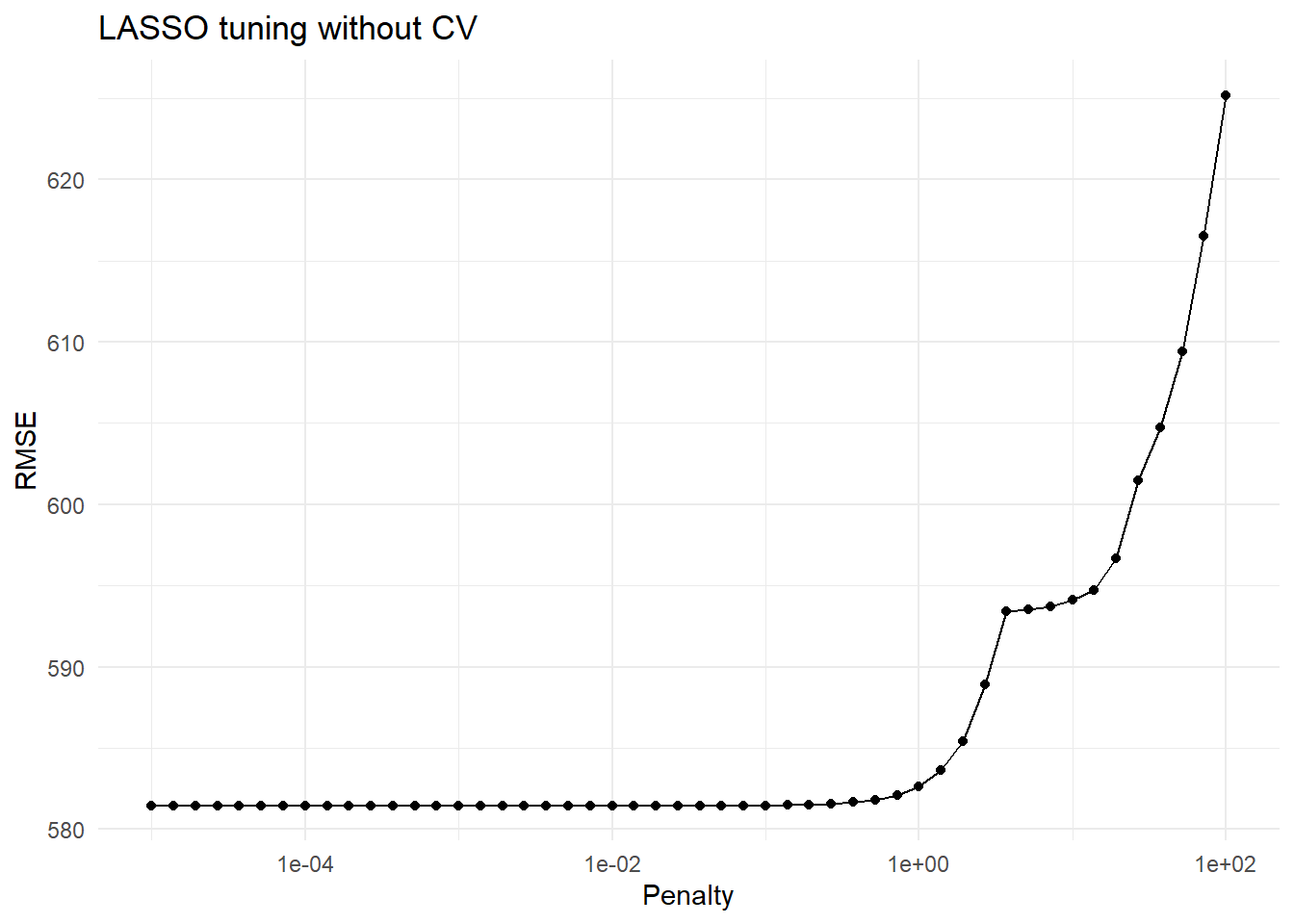
The LASSO tuning results show that the lowest RMSE occurs at very small penalty values, and RMSE increases as the penalty becomes larger. This happens because a small penalty makes the model behave similarly to ordinary linear regression, while larger penalties shrink the coefficients more strongly and reduce model flexibility. Since the linear model already fits the data well, increasing the penalty does not improve performance and instead makes it worse.

Random Forest tuning without CV

rf_model_tune <- rand_forest(
  mtry = tune(),
  min_n = tune(),
  trees = 300
) %>%
  set_engine("ranger", seed = rngseed) %>%
  set_mode("regression")

rf_recipe <- recipe(formula, data = dat) %>%
  step_dummy(all_nominal_predictors())

rf_workflow_tune <- workflow() %>%
  add_model(rf_model_tune) %>%
  add_recipe(rf_recipe)

rf_grid <- grid_regular(
  mtry(range = c(1, 7)),
  min_n(range = c(1, 21)),
  levels = 7
)

rf_app <- apparent(dat)

set.seed(rngseed)

rf_tune_no_cv <- tune_grid(
  rf_workflow_tune,
  resamples = rf_app,
  grid = rf_grid,
  metrics = metric_set(rmse),
  control = control_grid(save_pred = TRUE)
)

rf_preds_no_cv <- collect_predictions(rf_tune_no_cv)

rf_rmse_no_cv <- rf_preds_no_cv %>%
  group_by(mtry, min_n) %>%
  rmse(truth = Y, estimate = .pred)

rf_rmse_no_cv %>%
  arrange(.estimate)
# A tibble: 49 × 5
    mtry min_n .metric .estimator .estimate
   <int> <int> <chr>   <chr>          <dbl>
 1     7     1 rmse    standard        254.
 2     4     1 rmse    standard        255.
 3     3     1 rmse    standard        255.
 4     6     1 rmse    standard        256.
 5     5     1 rmse    standard        256.
 6     7     4 rmse    standard        285.
 7     6     4 rmse    standard        288.
 8     2     1 rmse    standard        290.
 9     4     4 rmse    standard        293.
10     5     4 rmse    standard        294.
# ℹ 39 more rows
ggplot(rf_rmse_no_cv, aes(x = factor(mtry), y = factor(min_n), fill = .estimate)) +
  geom_tile() +
  labs(
    title = "Random Forest tuning without CV",
    x = "mtry",
    y = "min_n",
    fill = "RMSE"
  ) +
  theme_minimal()

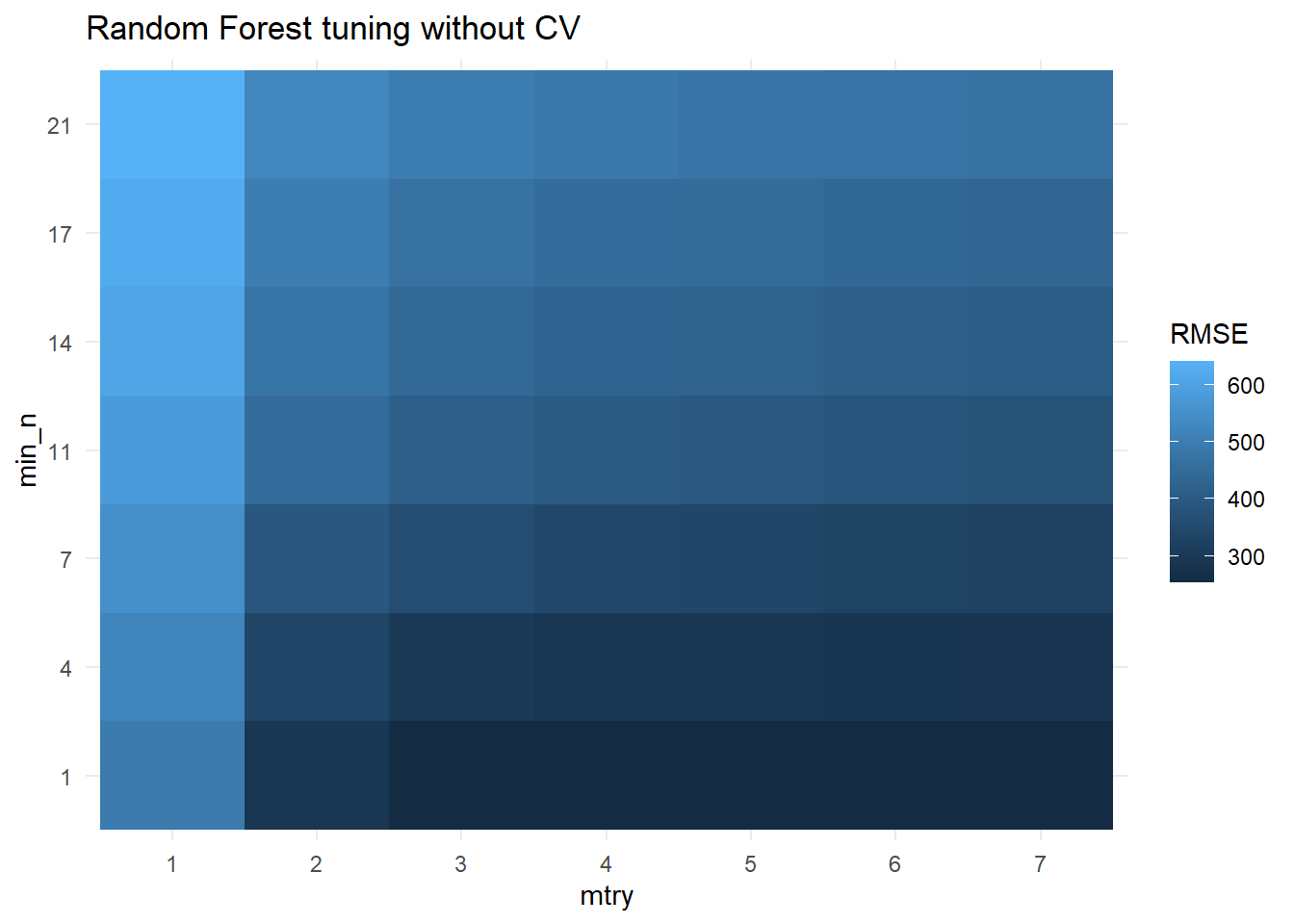
The random forest tuning results show that the lowest RMSE values occur for higher values of mtry and lower values of min_n. This combination allows the model to be more flexible and better fit the training data. Since tuning is performed without cross-validation, the model is evaluated on the same data used for training, which leads to very low RMSE values and potential overfitting. This demonstrates how flexible models like random forests can achieve strong performance on training data, but this may not generalize well to new data.

Tuning with cross-validation

LASSO tuning with CV

set.seed(rngseed)

folds <- vfold_cv(dat, v = 5, repeats = 5)

lasso_model_cv <- linear_reg(penalty = tune(), mixture = 1) %>%
  set_engine("glmnet")

lasso_workflow_cv <- workflow() %>%
  add_model(lasso_model_cv) %>%
  add_recipe(lasso_recipe)

lasso_grid <- tibble(
  penalty = 10^seq(-5, 2, length.out = 50)
)

lasso_tune_cv <- tune_grid(
  lasso_workflow_cv,
  resamples = folds,
  grid = lasso_grid,
  metrics = metric_set(rmse)
)

autoplot(lasso_tune_cv)

show_best(lasso_tune_cv, metric = "rmse")
# A tibble: 5 × 7
    penalty .metric .estimator  mean     n std_err .config         
      <dbl> <chr>   <chr>      <dbl> <int>   <dbl> <chr>           
1 0.1       rmse    standard    615.    25    20.5 pre0_mod29_post0
2 0.00001   rmse    standard    615.    25    20.5 pre0_mod01_post0
3 0.0000139 rmse    standard    615.    25    20.5 pre0_mod02_post0
4 0.0000193 rmse    standard    615.    25    20.5 pre0_mod03_post0
5 0.0000268 rmse    standard    615.    25    20.5 pre0_mod04_post0

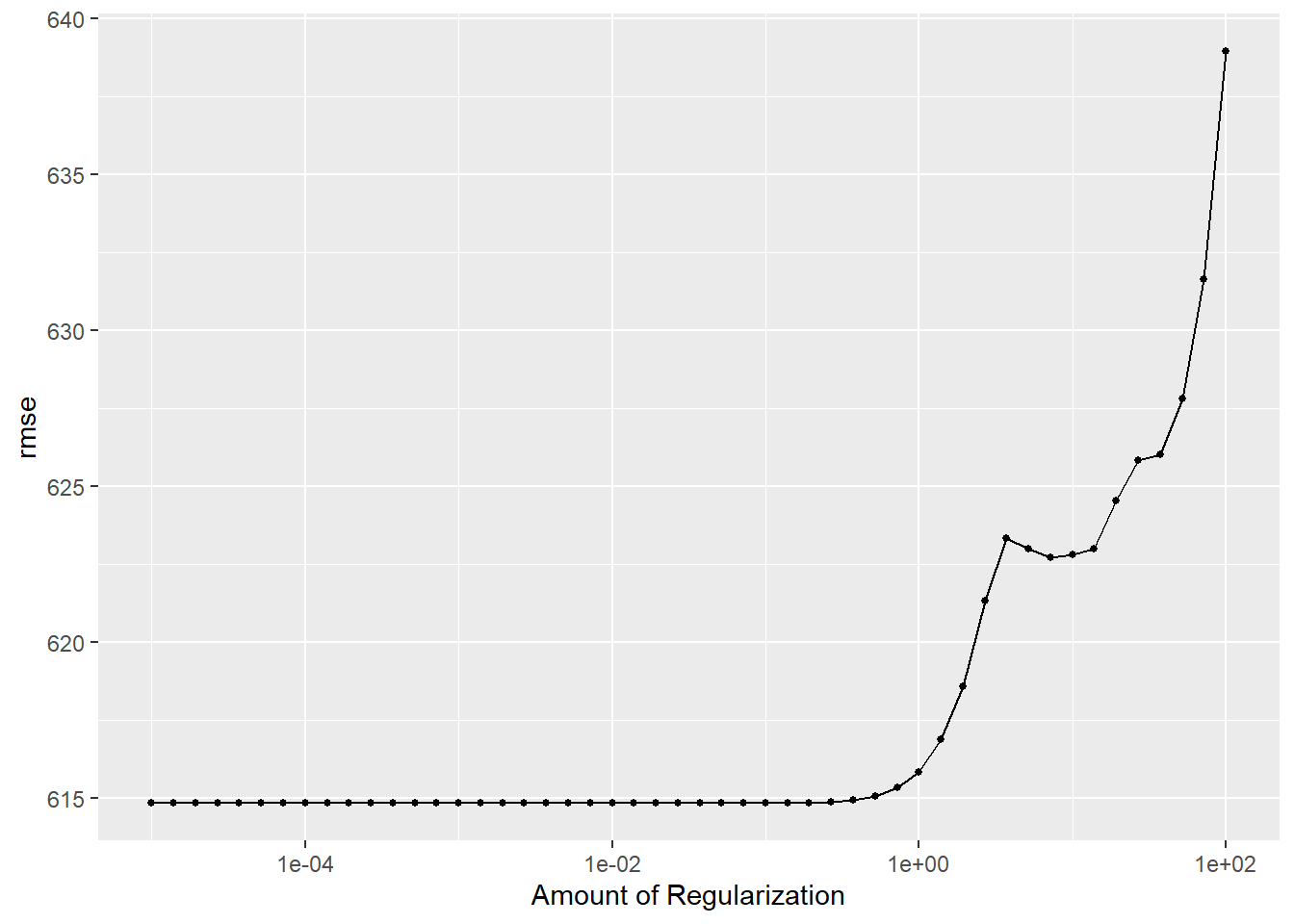
The LASSO tuning results using CV show that the best performance still occurs at small penalty values, with an RMSE of approximately 615. Compared to tuning without CV, the RMSE is higher, which is expected because the model is now evaluated on unseen data rather than the training data. This provides a more realistic estimate of performance and reduces overfitting. As the penalty increases, RMSE worsens because stronger regularization shrinks the coefficients and reduces model flexibility.

Random Forest tuning with CV

rf_model_cv <- rand_forest(
  mtry = tune(),
  min_n = tune(),
  trees = 300
) %>%
  set_engine("ranger", seed = rngseed) %>%
  set_mode("regression")

rf_workflow_cv <- workflow() %>%
  add_model(rf_model_cv) %>%
  add_recipe(rf_recipe)

rf_grid <- grid_regular(
  mtry(range = c(1, 7)),
  min_n(range = c(1, 21)),
  levels = 7
)

set.seed(rngseed)

rf_tune_cv <- tune_grid(
  rf_workflow_cv,
  resamples = folds,   # <-- your 5x5 CV here
  grid = rf_grid,
  metrics = metric_set(rmse)
)

autoplot(rf_tune_cv)

show_best(rf_tune_cv, metric = "rmse")
# A tibble: 5 × 8
   mtry min_n .metric .estimator  mean     n std_err .config         
  <int> <int> <chr>   <chr>      <dbl> <int>   <dbl> <chr>           
1     5    21 rmse    standard    670.    25    20.8 pre0_mod35_post0
2     6    21 rmse    standard    671.    25    21.0 pre0_mod42_post0
3     7    21 rmse    standard    672.    25    21.5 pre0_mod49_post0
4     4    21 rmse    standard    672.    25    21.0 pre0_mod28_post0
5     5    17 rmse    standard    673.    25    21.1 pre0_mod34_post0

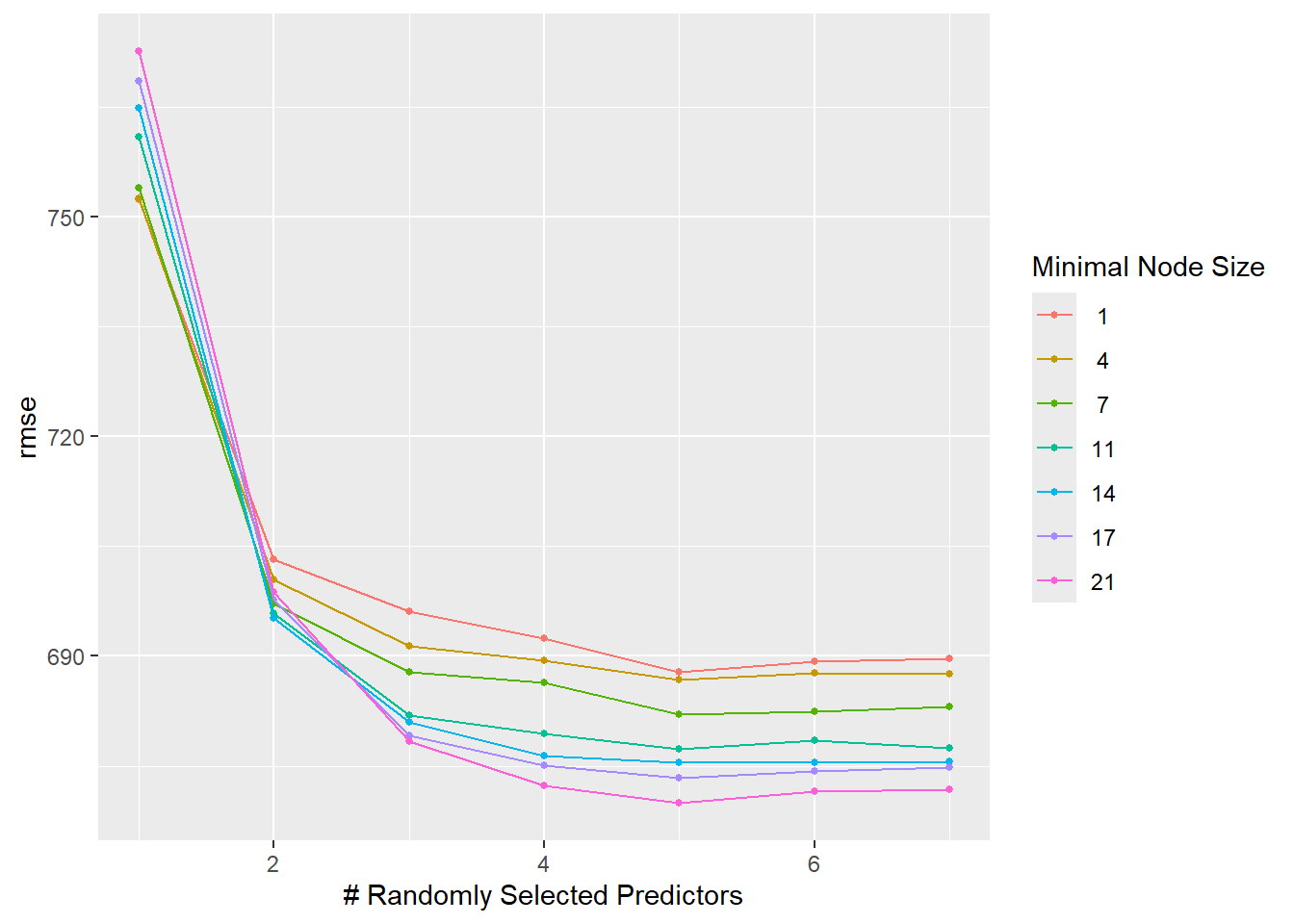
The random forest tuning results using CV show higher RMSE values compared to tuning without CV, indicating reduced overfitting and a more realistic estimate of performance. The best performance occurs at higher values of mtry and moderate values of min_n, which balance model flexibility and stability. Compared to the LASSO model, random forest now has a higher RMSE, suggesting that it does not generalize as well to unseen data in this case. This highlights that more complex models do not always perform better when evaluated properly.

Conclusion

This exercise showed that more flexible models can fit the training data very well, but this does not necessarily mean they generalize well to new data. In the first-fit setting, the random forest achieved the lowest RMSE because it was evaluated on the same data used for training. However, once tuning was performed with repeated cross-validation, the random forest performed worse than the LASSO model. The LASSO achieved the best overall performance under proper evaluation, indicating that a simpler regularized model generalized better for this dataset.

Notes on AI use: AI tools (ChatGPT) were used to assist in understanding the coding and refining explanations.