This synthetic data example was inspired by the synthetic data demonstrations provided in MADA course Model4.
Introduction
For this example, we generate a simple dataset for a hypothetical dietary intervention and its impact on outcomes such as body weight and gastrointestinal side effects. The data are fully synthetic and are used to demonstrate data generation, exploration, and simple modeling.
Data generation
We generate synthetic data for a hypothetical dietary intervention study. Individuals are assigned to one of two diet groups and followed over time. Body weight and gastrointestinal side effects are recorded.
# Set seed for reproducibilityset.seed(123)# Number of participantsn_participants <-30# Number of weeksn_weeks <-8# Diet groupsdiet_groups <-c("Standard Diet", "High Fiber Diet")# Participant-level dataparticipants <-data.frame(ParticipantID =1:n_participants,DietGroup =sample(diet_groups, n_participants, replace =TRUE),Age =round(rnorm(n_participants, mean =40, sd =12)))# Expand to weekly observationsdiet_data <- participants[rep(1:n_participants, each = n_weeks), ]diet_data$Week <-rep(1:n_weeks, times = n_participants)# Generate body weight (kg)diet_data$BodyWeight <-with(diet_data, { baseline <-ifelse(DietGroup =="Standard Diet", 80, 78) age_effect <-0.08* (Age -40) week_effect <--0.3* Week noise <-rnorm(nrow(diet_data), mean =0, sd =1.5) baseline + age_effect + week_effect + noise})# Probability of gastrointestinal side effectsgi_prob <-plogis((diet_data$BodyWeight -75) /5)diet_data$GISideEffect <-rbinom(nrow(diet_data),size =1,prob = gi_prob)# Check datahead(diet_data)
    ParticipantID     DietGroup Age Week BodyWeight GISideEffect
1               1 Standard Diet  61    1   79.69534            1
1.1             1 Standard Diet  61    2   80.47567            0
1.2             1 Standard Diet  61    3   80.08002            1
1.3             1 Standard Diet  61    4   81.64995            1
1.4             1 Standard Diet  61    5   80.05495            0
1.5             1 Standard Diet  61    6   80.25998            1
table(diet_data$DietGroup)
High Fiber Diet   Standard Diet
            104             136
summary(diet_data$Age)
   Min. 1st Qu.  Median    Mean 3rd Qu.    Max.
   16.0    32.0    38.5    40.2    50.0    66.0
Data exploration
Now exploring the structure of the synthetic dataset and summarizing key variables to confirm that the data were generated as expected.
# Check the size of the datasetdim(diet_data)
[1] 240 6
# Check variable types and structurestr(diet_data)
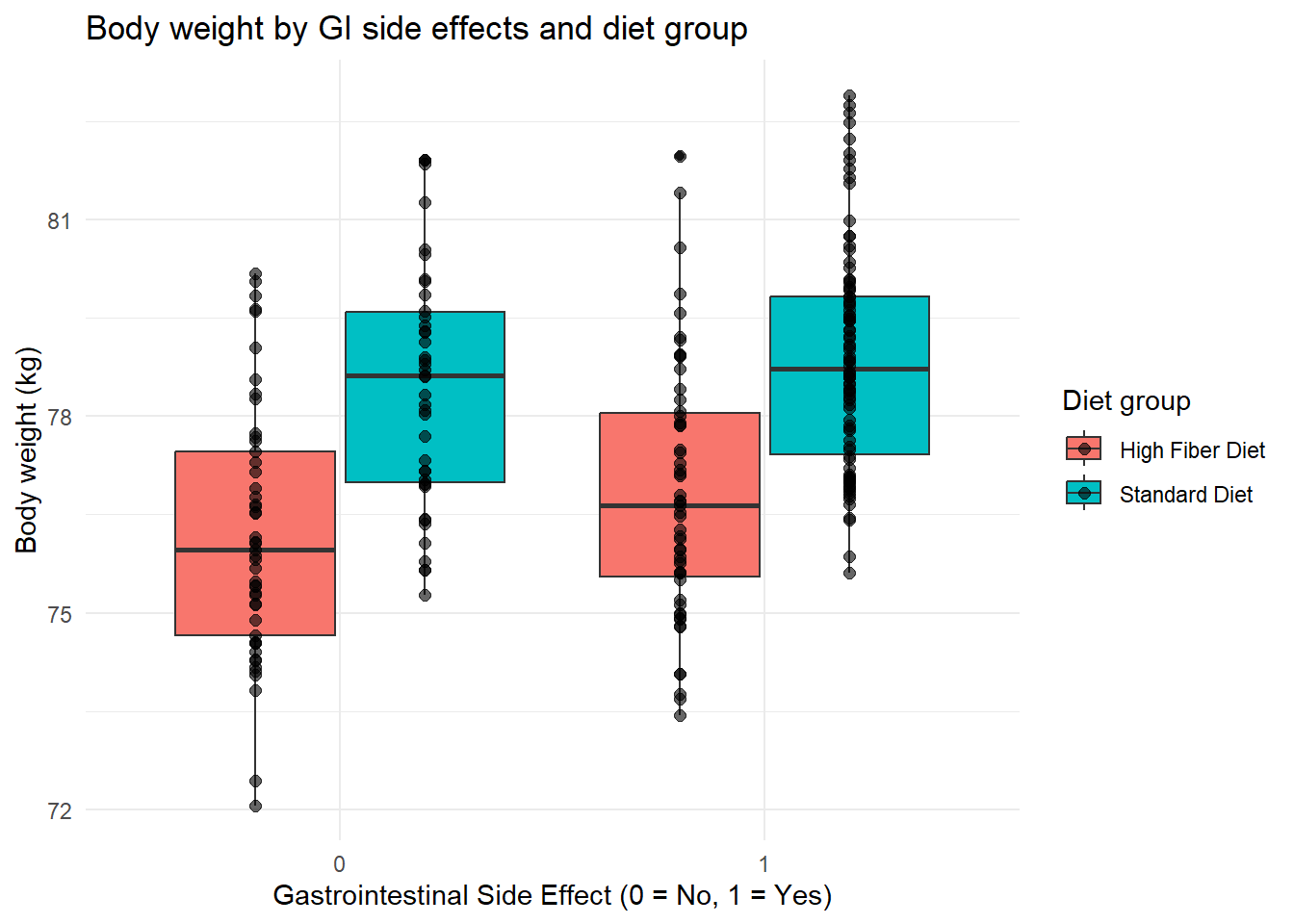
ggplot(diet_data,aes(x =as.factor(GISideEffect),y = BodyWeight,fill = DietGroup)) +geom_boxplot(position =position_dodge(width =0.8)) +geom_point(position =position_dodge(width =0.8),alpha =0.6, size =2) +labs(x ="Gastrointestinal Side Effect (0 = No, 1 = Yes)",y ="Body weight (kg)",title ="Body weight by GI side effects and diet group",fill ="Diet group" ) +theme_minimal()
Simple modeling
We fit simple models to assess the association between diet group, time, and body weight, as well as the relationship between body weight and the probability of gastrointestinal side effects.
# Linear model: body weight as a function of time, diet group, and agemodel_weight <-lm( BodyWeight ~ Week + DietGroup + Age,data = diet_data)summary(model_weight)
Call:
lm(formula = BodyWeight ~ Week + DietGroup + Age, data = diet_data)

Residuals:
    Min      1Q  Median      3Q     Max
-3.4388 -0.8793 -0.1217  0.8367  4.8225

Coefficients:
                        Estimate Std. Error t value Pr(>|t|)
(Intercept)            74.621824   0.376468 198.215  < 2e-16 ***
Week                   -0.288293   0.039857  -7.233 6.55e-12 ***
DietGroupStandard Diet  2.032900   0.185015  10.988  < 2e-16 ***
Age                     0.082460   0.007706  10.701  < 2e-16 ***
---
Signif. codes:  0 '***' 0.001 '**' 0.01 '*' 0.05 '.' 0.1 ' ' 1

Residual standard error: 1.415 on 236 degrees of freedom
Multiple R-squared:  0.568, Adjusted R-squared:  0.5625
F-statistic: 103.4 on 3 and 236 DF,  p-value: < 2.2e-16
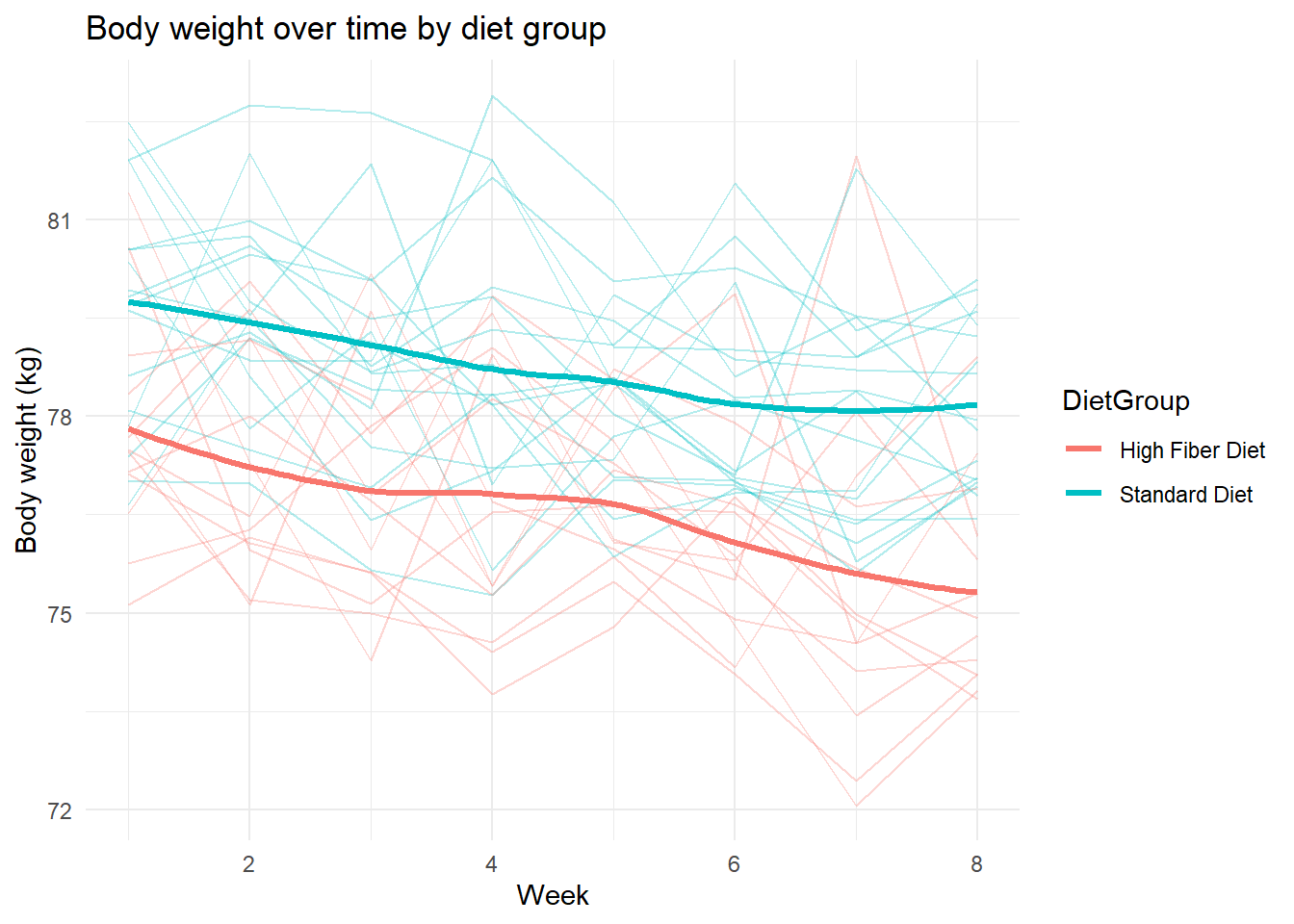
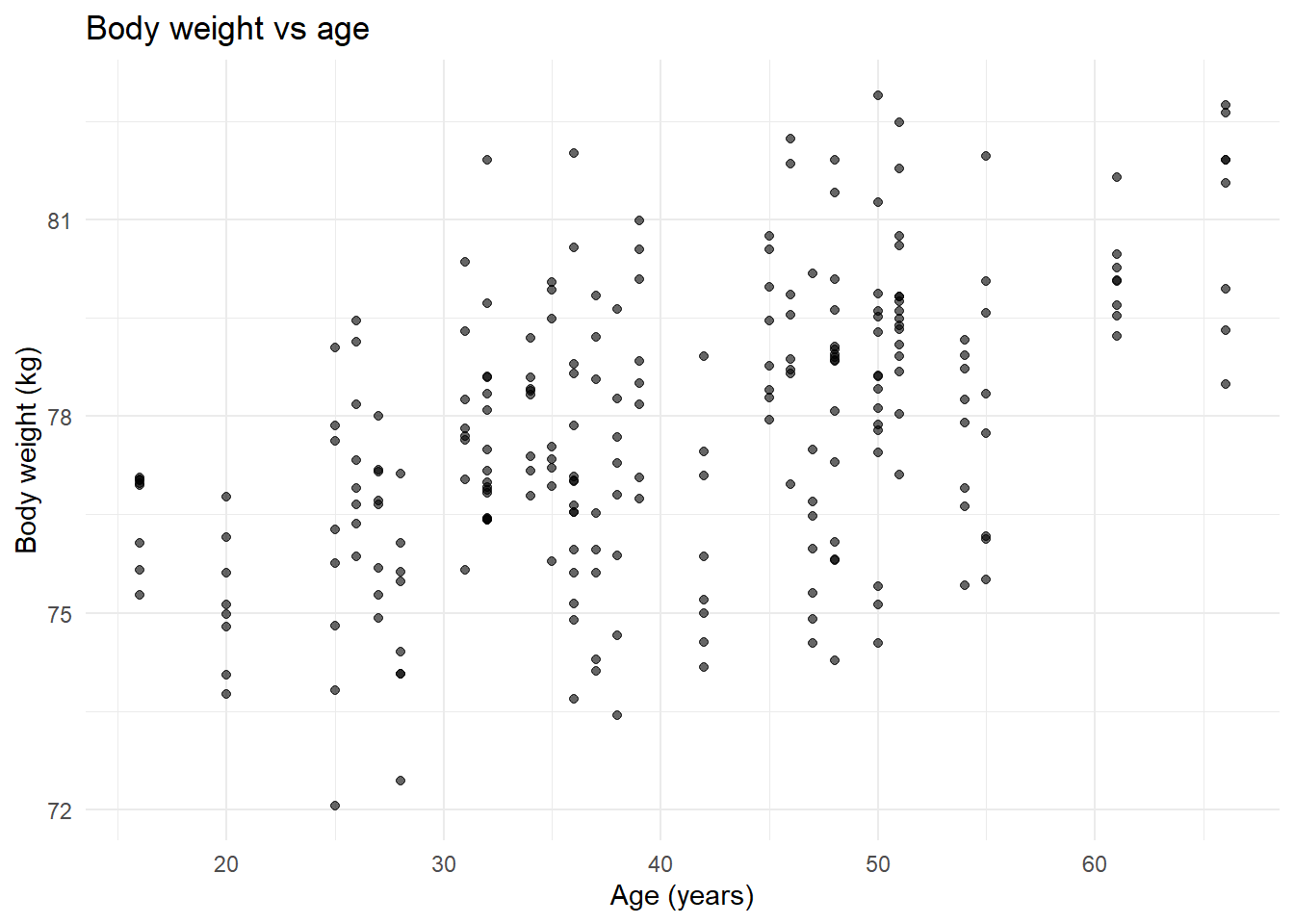
The linear regression model indicates that body weight is significantly associated with time, diet group, and age. Body weight decreases over time, reflecting the negative weekly trend built into the data generation process. Participants assigned to the standard diet have higher body weight compared to those on the high-fiber diet, and older participants tend to have slightly higher body weight.
# Logistic model: GI side effects as a function of body weight, diet group, and agemodel_gi <-glm( GISideEffect ~ BodyWeight + DietGroup + Age,data = diet_data,family = binomial)summary(model_gi)
Call:
glm(formula = GISideEffect ~ BodyWeight + DietGroup + Age, family = binomial,
    data = diet_data)

Coefficients:
                       Estimate Std. Error z value Pr(>|z|)
(Intercept)            -9.09259    6.50152  -1.399    0.162
BodyWeight              0.11458    0.08829   1.298    0.194
DietGroupStandard Diet  0.42843    0.32434   1.321    0.187
Age                     0.01131    0.01362   0.830    0.406

(Dispersion parameter for binomial family taken to be 1)

    Null deviance: 318.55  on 239  degrees of freedom
Residual deviance: 307.09  on 236  degrees of freedom
AIC: 315.09

Number of Fisher Scoring iterations: 4
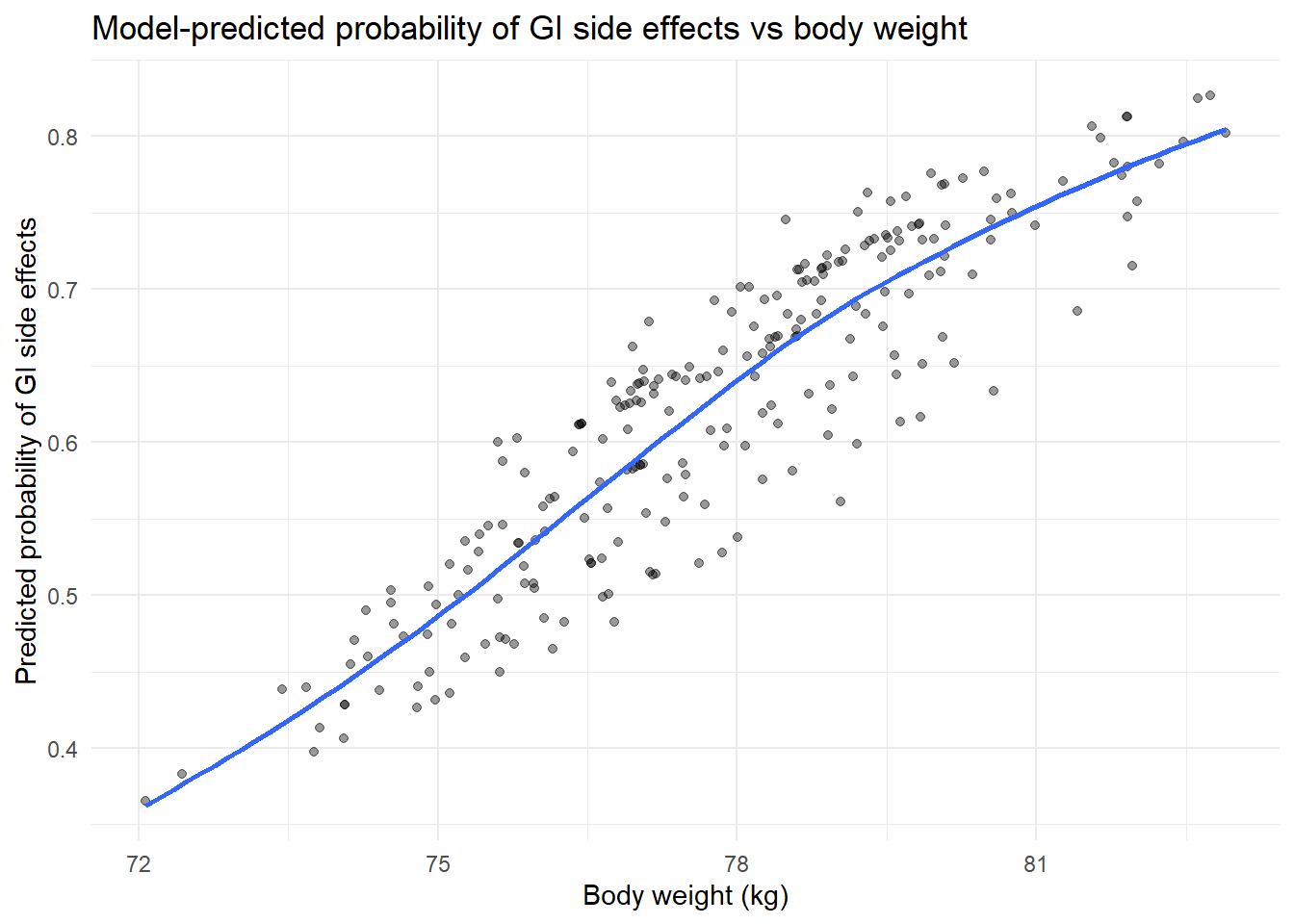
While the body weight has a positive association with the probability of gastrointestinal side effects, this association was not statistically significant. After accounting for body weight, diet group and age were not strongly associated with gastrointestinal side effects as well.
# Predicted probabilities from logistic modeldiet_data$PredictedProbGI <-predict( model_gi,type ="response")
ggplot(diet_data,aes(x = BodyWeight, y = PredictedProbGI)) +geom_point(alpha =0.4) +geom_smooth(se =FALSE) +labs(title ="Model-predicted probability of GI side effects vs body weight",x ="Body weight (kg)",y ="Predicted probability of GI side effects" ) +theme_minimal()
`geom_smooth()` using method = 'loess' and formula = 'y ~ x'
Conclusion
In this study we have a fully synthetic dataset that mimic a simple dietary intervention study. We explored how diet group, time, and age were related to body weight, and how body weight was related to gastrointestinal side effects. The analysis showed that body weight decreased over time, differed between diet groups, and increased slightly with age. The logistic regression model suggested that higher body weight was associated with a higher probability of gastrointestinal side effects, although this relationship was not statistically significant, and diet group and age did not show strong direct associations with GI side effects. Overall, this exercise demonstrates how synthetic data can be used to explore relationships between variables and to check whether simple models reflect known data-generation mechanisms.
Notes on AI use: AI tools (ChatGPT) were used in away to help clarify R syntax and structure the synthetic data generation and modeling workflow